

*This post may contain affiliate links for which I earn commissions.*
Starting an online business later in life can feel a bit like showing up to a conversation that has already been going on for years.
Everyone seems to be selling a shortcut, a secret system or a “proven blueprint” (yeah, right.)
When you are brand new, it is hard to tell what is genuinely helpful and what is just polished marketing.
Hint: a lot of it is polished marketing. Often, the sales letter or video is better produced than the course content.
So you get confused, and that confusion gets expensive fast.
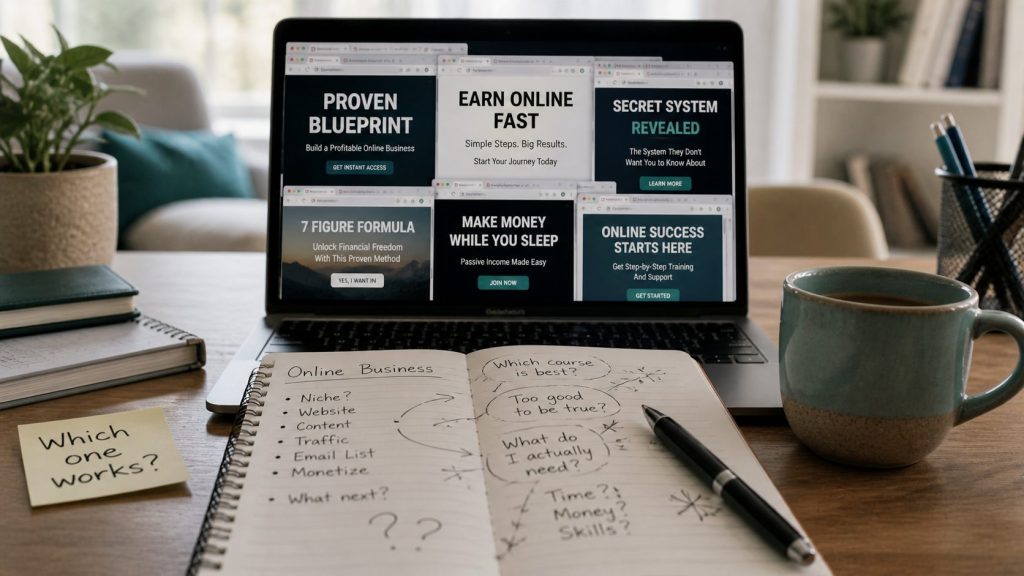
Now, I’m not putting down all paid courses. I’ve bought tons of them too, including one this week. Some of them are excellent (too few, alas.)
In fact, when I started out, a paid course on affiliate marketing got me started on the right path. Before that, I was flailing my arms wildly online and getting nowhere.
The truth is, a paid course can absolutely be useful when you are starting out, but not every course deserves your time, money or trust.
Some are well-structured, practical and built to help beginners make real progress. Others are mostly excitement, vague promises and pressure tactics wrapped in a nice sales page.
The tricky part is that both can look very similar at first glance. It’s tough to tell them apart.
Over the years, I learnt a thing or three about evaluating online courses before buying them.
These steps can help you spot real value, slow down emotional decisions and figure out whether a course is the right next step for you and not just the loudest offer in your feed.
If you already know what you should be doing but keep putting it off, getting distracted or jumping between ideas, that is a different problem. In that case, consistency and accountability support usually help more than another course.
Start With The Real Question, Not The Sales Page
Before you even look at testimonials, bonuses or pricing, pause and ask a more useful question:
What exact problem am I trying to solve right now?
That one question can save you from buying a course you do not need yet.
A lot of beginners purchase courses because they feel left behind. They worry everyone else already knows the tech, the terms and the “right” strategy.
So when a course promises clarity, confidence and a step-by-step plan, it can feel like relief.
However, relief is not the same thing as good fit.
For example, maybe you think you need a full affiliate marketing course. But maybe what you really need is much more specific, like:
- choosing a niche
- setting up a basic WordPress site
- understanding how affiliate links work
- learning how to write your first helpful blog post
If your real problem is pretty narrow, buying a giant course with 12 modules, three private groups, weekly calls and a pile of bonuses may be complete overkill.
Or a severe distraction that knocks you off the tracks.
You end up paying for complexity when all you really needed was a clean first step.
This is especially important if you are balancing work, family or other responsibilities. A huge course library may sound generous, but if it overwhelms you, it is not helping.
If your main struggle right now is actually following through on simple steps rather than figuring out what to do, you may not need more information. You may need a structure that keeps you accountable day after day.
Look For Specific Outcomes, Not Big Emotions
Good courses usually explain what you will learn in a clear, grounded way. Hype-driven courses often lean harder on emotion than substance.
That does not mean strong marketing is always bad. A creator can be enthusiastic and still offer something valuable.
The issue is whether the course description gives you specific, practical outcomes or just tries to stir urgency and desire.
- The lessons are clearly outlined
- The course says who it is for and who it is not for
- It explains what you should be able to do by the end
- It gives realistic expectations about time and effort
- It focuses on skills and systems not just income fantasies
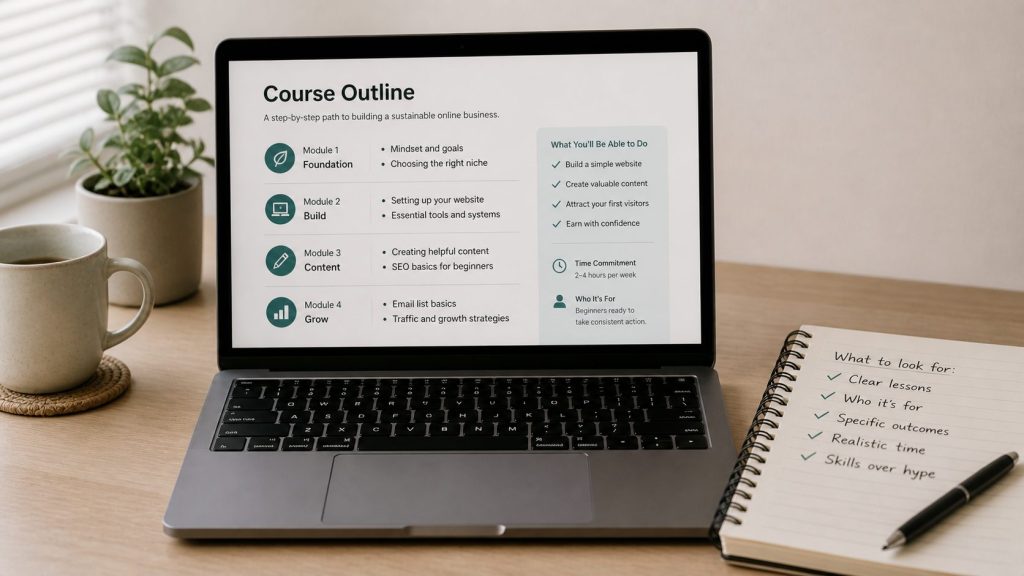
When the emotional pressure is stronger than the educational details, that is a big red flag.
A simple test helps here. Could you explain what the course teaches after reading the sales page?
If your answer is vague, that is not a good sign.
Clarity is usually a good sign. Fog is usually not.
Check The Teacher, But Also Check The Teaching
Many people make the mistake of asking only one question. Is this person successful?
That matters, of course. But success alone does not make someone a good teacher.
A person may have built a strong business years ago and still be terrible at explaining things to beginners.
So instead of asking only whether the creator has results, ask better questions.
Can They Teach In A Beginner-Friendly Way?
Look at how they explain things. Do they simplify, define terms and break decisions into steps?
Do They Seem More Interested In Helping Than Impressing?
Some instructors talk endlessly about their wins. Others focus on helping you understand what to do next.
The second type is usually more useful.
Is Their Teaching Style A Match For You?
This part is personal, and it matters more than people think.
As an aside, I hate plodding through video instructions. I learn far better from written content and illustrations. There are excellent courses with very long videos. Great content, but they’re not for me.
So a course can be really good and still not be quite right for you.
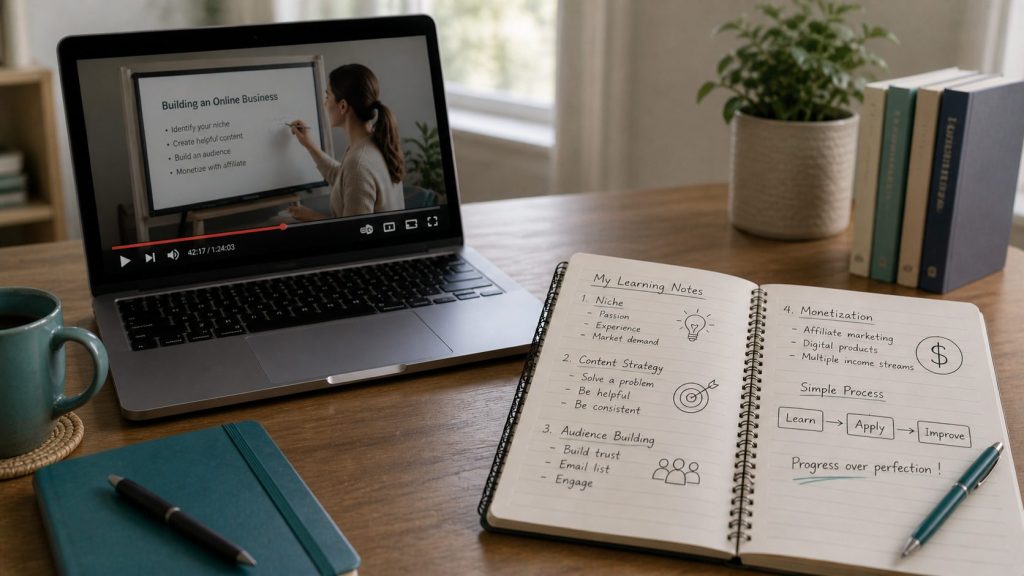
The best course is not always the one presented by the most magnetic personality. It is the one that helps you take the next step with the least confusion.
Use A Simple Course Filter Before You Spend Money
When you are tempted to buy, do not decide in the moment. Use a simple review framework before you pull out your card.
The Course Fit Check
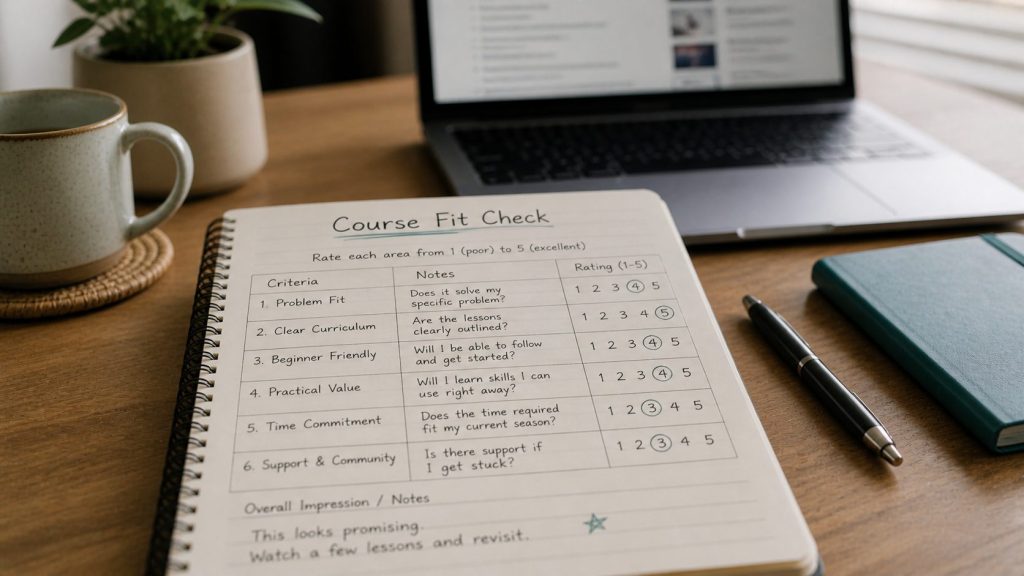
Does this solve my actual current problem? Can I see what is included? Is it genuinely beginner-friendly? Will I get something usable out of it?
Are the promises realistic, with no hype or overnight claims? Do I like how this person teaches? Will I actually use this soon? Can I afford it without stress? And finally, can I solve this cheaper?
If you keep buying courses but not finishing them, the issue is usually not the course. It is consistency. In which case, a simple accountability system can often fix things faster than another course purchase.
Helpful Tools To Make Course Decisions Easier
Use Google Sheets, Microsoft Excel or Apple Numbers for this purpose.
They’re simple to use and very effective for comparing options side by side.
Practical Steps You Can Try Today
Write down the exact problem you are trying to solve. Then look at one or two courses, run them through the questions above and check whether there is decent free content covering the same ground.
Wait 24 hours before paying. Then ask yourself one last thing: are you buying progress, or just buying hope?
Hope is not a bad thing. Many entrepreneurs would never have been successful if they didn’t hold on to hope in the middle of repeated failures. But hope should not be the only thing driving the decision.
If you want a simple structure to stay consistent over the next 30 days without jumping between courses, you can see how the accountability setup works.
Learn To Tell The Difference
A paid course can be worth it when you are just starting, but only if it gives you the right help at the right time.
The goal is not to avoid courses. It is to get better at telling the difference between real education and persuasive marketing.
You do not need the biggest course or the loudest mentor. You just need enough clarity to make your next wise move.
Starting smart is better than starting perfect.