*This post may contain affiliate links for which I earn commissions.*
It usually starts with good intentions.
You want to make smart decisions, avoid scams, and understand what you are doing before you put time or money into an online business. Sounds fair enough.
So you read blog posts, watch YouTube videos, download free guides, compare tools, and maybe even take a course or two. On the surface, that looks like progress. It feels responsible.
For many beginners over 40, it even feels MUCH safer than jumping in too quickly.
But there is a hidden trap in all that learning. At some point, research stops being preparation and starts becoming procrastination (in a nicer outfit, though!).
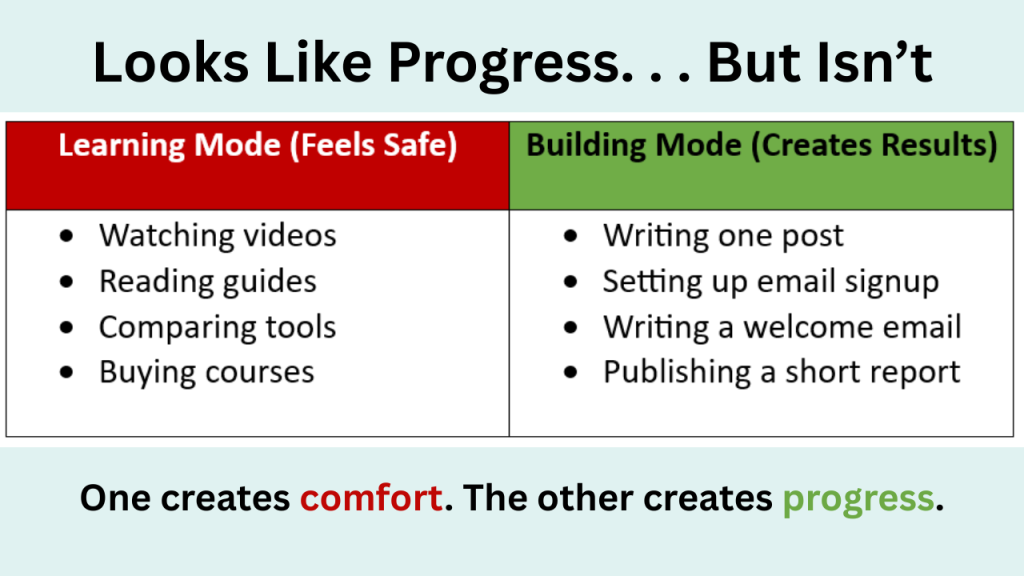
You stay busy, but you are not actually building anything. No post is published. No offer is outlined. No email signup is created. No small business asset starts taking shape.
If that sounds familiar, you are not behind, and you are definitely not the only one. This post will help you spot when learning is helping and when it is quietly holding you back. More importantly, it will show you how to shift from consuming information to creating something real, even if you still feel unsure.
I can’t tell you how many times I’ve fallen prey to this exact trap. I remember one time when I felt I wasn’t up to date on the latest online promotion techniques.
So I bought a few courses on the topic. Before I knew it, I was down $1,500+ in course purchase expenses and more importantly, had lost close to 2 months doing almost nothing productive – no real output – just consuming videos and reading stuff! 🙁
Why Research Feels So Productive
One reason this trap is so common is because learning feels useful. And to be fair, some of it is.
If you are brand new to affiliate marketing, digital products, or online tools, you do need a foundation. You need to understand the basic moving parts before you start making decisions.
The problem is that learning gives you a small sense of accomplishment without requiring the discomfort of action. You can spend two hours watching tutorials and walk away thinking, “I’m really getting somewhere.”
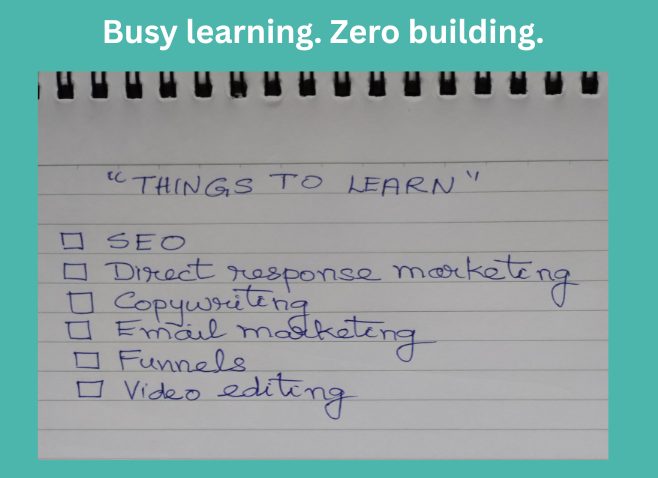
Meanwhile, the harder but more meaningful task, like writing your first blog post or choosing your first audience, keeps getting pushed to tomorrow.
For beginners over 40, there is often another layer. You may be used to doing things thoroughly in your career and personal life. You want to be competent before you begin.
That mindset has probably served you well in many areas. Online business, though, often rewards messy progress more than perfect preparation.
You do not need to know everything before you start. You need to know enough to take the next sensible step.
The Real Cost Of Learning Too Much
The cost of over-learning is not just lost time. It also drains confidence.
The more advice you consume, the more conflicting opinions you find. One expert says start with blogging. Another says skip blogging and build an email list. One says Pinterest is a goldmine. Another says social media is a total distraction.
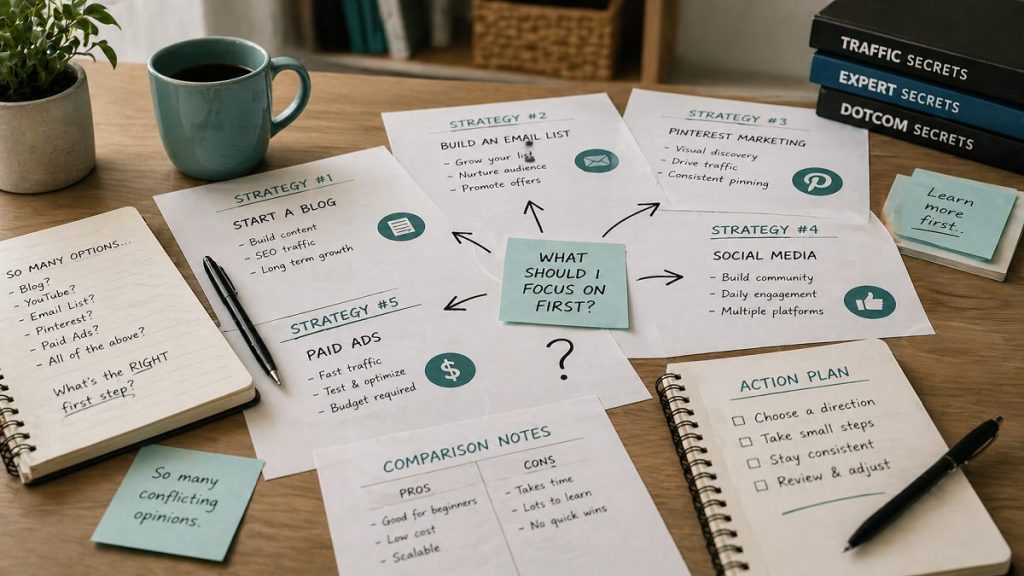
One says you need paid tools right away. Another says keep it all free until you earn your first dollar.
Until finally, the whole thing becomes clear as mud to you. . .
After a while, your brain starts to treat every decision like a high-stakes choice. That makes simple actions feel far heavier than they need to be.
This is where many beginners stall out. They start thinking they need the perfect niche, the perfect platform, the perfect tool stack, and the perfect plan. In reality, what they need is one small project they can actually finish.
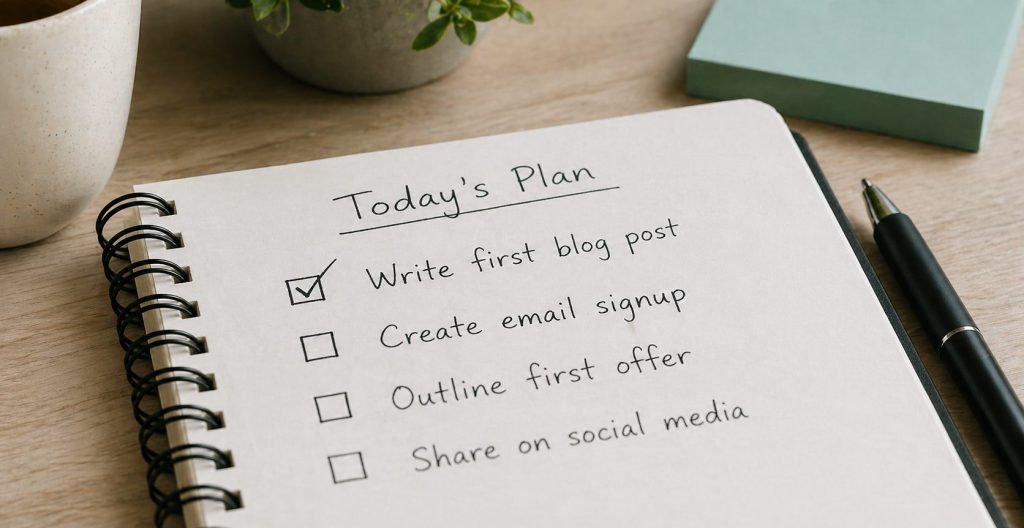
A simple blog post teaches you more than ten videos about blogging.
Creating a basic freebie / lead magnet teaches you more than three webinars on digital products. (If you don’t believe me, try it.) And actually setting up one email form teaches you more than hours of comparing email platforms.
Building creates clarity that learning alone never can.
How To Tell When It Is Time To Stop Learning
So how do you know when enough is enough?
A good rule is this: if you have consumed information on the same topic three or four times and still have not taken action, the issue is probably no longer lack of knowledge. It is hesitation.
Here are a few signs you may be stuck in research mode:
- You keep saving tutorials but rarely finish implementing them
- You are comparing beginner tools for tasks you have not even started yet
- You tell yourself you need “one more course” before launching
- You spend more time organizing ideas than testing them
- You feel mentally exhausted, but have little to show for it
That last one matters. Real progress usually leaves some evidence behind. A draft. A published page. A content outline. A lead magnet idea. A checklist. Something you can point to and say, “I made this.”
If your effort only lives in notes, bookmarks, and browser tabs, it may be time to switch gears.
Start Building BEFORE You Feel Ready
This is the part many people resist, but it is also where momentum begins.
You do not have to feel ready to create something useful. You just need a small enough project that you can finish it without spinning out of control. Think in terms of making practice pieces, not world-class masterpieces.
For example, instead of saying, “I need to build my whole affiliate site,” say, “Today I will draft one beginner-friendly post idea for my audience.”
Instead of, “I need to create a digital product,” say, “I will outline a one-page checklist that solves this one single small problem.”
Instead of, “I need to figure out email marketing,” say, “I will write a simple welcome email draft.”
This kind of smaller thinking is not playing small. It is building smart.
Beginners often assume real progress looks big and impressive. Usually it looks ordinary. And often boring too.
A rough draft. A test page. A simple opt-in. A first review post that is not brilliant, but is finally live. Those small builds matter because they move you from theory into experience.
And experience is where confidence starts to grow.

A Simple Framework To Move From Consuming To Creating
When you feel yourself drifting back into endless learning, use this simple framework:
1. Choose One Business Goal
Pick one practical goal for the next 30 days.
Examples:
- Publish 3 blog posts
- Set up a basic email list
- Create a simple affiliate resource page
- Outline your first digital product
One goal is enough. More than that usually scatters your focus.
2. Limit Learning Time
Give yourself a time container for research.
Try this:
- 30 minutes learning
- 60 minutes building
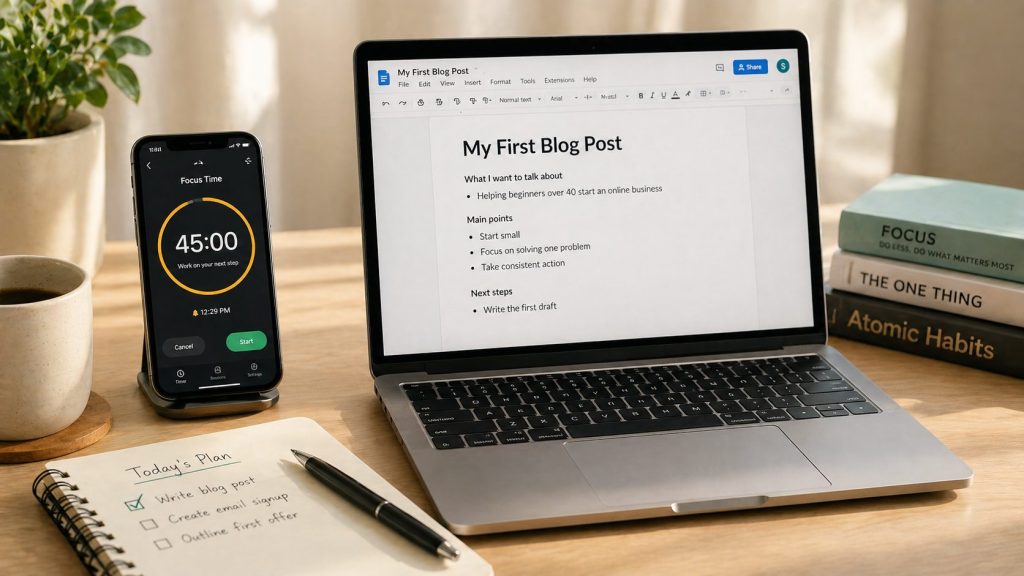
This keeps learning in its proper place, as support for action, not a substitute for it.
3. Build The Smallest Useful Version
Ask, “What is the simplest version of this I can complete this week?”
That might be:
- One blog post instead of a full content plan
- One free checklist instead of a full course
- One email sequence draft instead of a full automation system
Finished beats fancy.
4. Review What You Created
At the end of the week, look at what exists now that did not exist before.
That simple review builds motivation. It reminds you that progress is not just something you think about. It is something you can see.
If you’ve tried working this way before and found yourself slipping back into research mode after a few days, that’s more common than it seems.
In most cases, the issue is not lack of knowledge. It is consistency.
This is exactly the gap I try to address with a simple accountability setup I offer. There is no strategy or training involved. You continue with your own plan. The idea is simply to have a steady structure and someone in your corner so that the work actually gets done.
If that feels like something you might need at this stage, you can read more about it here.
Practical Steps You Can Try This Week
Here is a quick checklist to help you break the learning loop right away:
- Pick one project you have delayed for at least two weeks
- Write down the next physical action, not the whole plan
- Set a 45-minute timer and work only on building
- Close extra tabs, videos, and comparison articles
- Finish a rough version before improving anything
- Save new research for later unless you are truly blocked
- At the end, note what you completed and what the next step is
That is enough to restart momentum.
A simple tool that can help here is Trello or even a basic digital checklist app like Google Keep. Trello is especially helpful if your ideas tend to pile up in your head. You can create three columns: Learn, Build, and Done.
Most beginners do best when they keep the Build column very small and very clear. If you get overwhelmed easily, a plain checklist may actually be better than a more complex project management tool. Simpler often wins.
I don’t use Trello or similar stuff nowadays. I use a well-designed physical planner. Somehow, that gives my ideas / next actions a certain solidity and “realness” that I simply can’t get from any digital thingy. . .
Here’s what it looks like, click the image to check it out yourself:

Clever Fox Weekly & Monthly Planner

Starting Smart Means Creating Early
There is nothing wrong with learning. In fact, good learning can save you time, money, and frustration. But once learning becomes your main activity, it can quietly delay the very progress you want.
The truth is, you will understand this business much better by building one imperfect thing than by studying twenty perfect examples.

So if you have been stuck in research mode, take that as a sign, not of failure, but of readiness. You have probably learned enough to begin. What you need now is not more input. It is one small act of creation.
Start with something simple. Start with something useful. Start before it feels polished.
And if you find that starting is not the hard part, but continuing is, a small layer of accountability can make that difference. Even a light structure or a simple check-in can help turn good intentions into finished work.
That is how real online businesses begin, especially for people who want to build them calmly, wisely, and without hype. Starting smart is better than starting perfect, every single time.