
*This post may contain affiliate links for which I earn commissions.*
If you’ve spent 20 or 30 years in a corporate job, stepping into entrepreneurship can feel like learning a new language from scratch.
Or worse!
You’re used to structure. Clear roles. And most importantly, a predictable income (that’s the thing I missed the most when I moved out of a job!)
Now suddenly you’re being told to “build a personal brand,” “create digital products,” or “start an email list” and it can feel overwhelming.
Not to mention quite unrealistic too, which is how I felt when I got started.
Here’s something most people won’t say clearly enough. . .
. . .You DON’T need to quit your job or take big risks to start building confidence as an entrepreneur.
There’s a much smarter – and safer – way to transition.
I’ll show you how to slowly shift your identity, build small wins, and test ideas quietly. That way, you can grow real entrepreneurial confidence while still keeping the safety of your current job.
Also, there are folks out there – some in senior corporate roles – who never quit their jobs although they built a very profitable online business on the side!
They enjoy the senior corporate role way too much to let it go.
So it’s definitely not mandatory to quit your job at ANY stage of your entrepreneurial journey, if you don’t want to.
1. Start With an Identity Shift, Not a Business Plan
You can start by thinking a little differently.
That probably sounds backwards. But here’s the thing.
One of the biggest mental blocks for midlife beginners is the thought,
“I’m not an entrepreneur.”
That belief alone can stop you before you even begin.
But here’s a more useful way to look at it. You don’t need to become an entrepreneur overnight. You just need to start behaving like one in small, low-risk ways.
Instead of saying:
“I need to start a business”
Start saying:
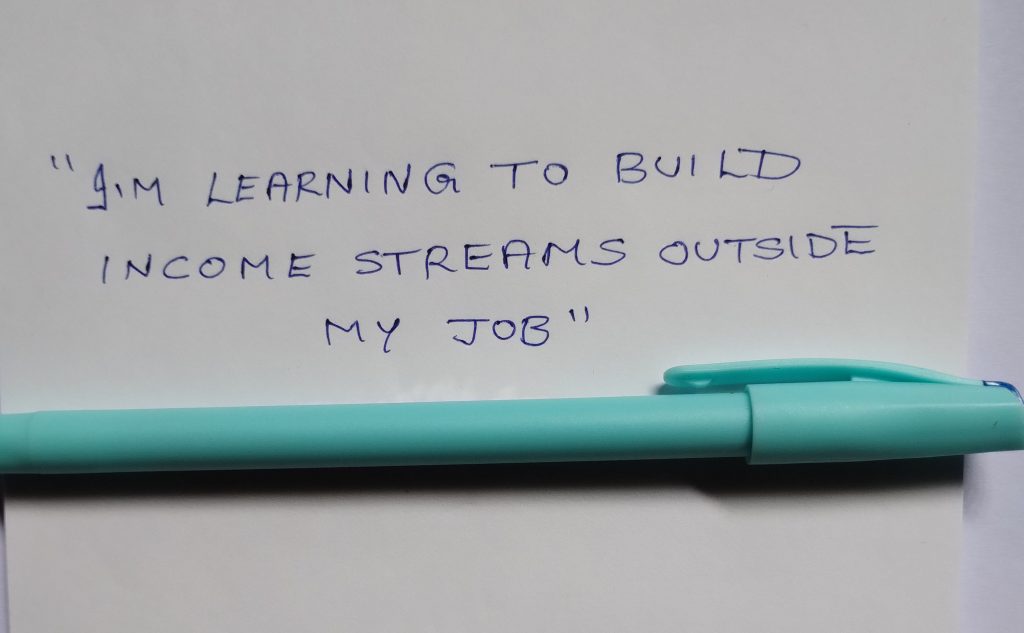
“I’m someone who is learning how to build income streams outside my job”
That subtle shift matters.
Your corporate career has already given you valuable skills. Communication, problem solving, organization, industry knowledge.
Entrepreneurship is simply about applying those skills differently, in another context.
You could view this phase as an apprenticeship, not a dramatic leap.
You’re not leaving your career behind. Instead, you’re expanding your options.
2. Build Confidence Through Small, Visible Wins
As I’ve said elsewhere, confidence doesn’t come from reading more or watching more videos.
It comes from doing small things and seeing results.
The mistake many beginners make is trying to build something too big, too fast. A full website, a complete course, a perfect business plan.
That usually leads to burnout or second-guessing. And eventually, you end up abandoning the whole idea.
Instead, focus on small wins that are easy to achieve and easy to measure.
It just has to exist.
For example:
- Writing your first helpful post online
- Creating a simple checklist or resource
- Getting your first email subscriber
- Receiving a reply or comment from someone who found your content useful
These may seem too minor to count. But in fact, they are powerful signals that tell your brain:
“This is working. I can do this.”
Each small win reduces fear and builds momentum.
Over time, those small actions stack into real confidence.
3. Test Ideas Quietly Before You Commit
You don’t need to announce your new “business” to the world.
If you hold a midlevel or senior position in the corporate world, letting the whole world know about it could lead to serious problems within your company.
Even if that’s not the case, it’s usually better to keep it quiet.
Early-stage entrepreneurship works best when it’s treated like a private experiment.
You can:
- Start a simple blog under a pen name
- Share content on Pinterest or Medium without personal exposure
- Build a small email list focused on a niche topic
- Test different ideas without pressure
This removes one of the biggest fears people have:
“What if I fail and everyone sees it?”
When you test quietly, failure becomes feedback instead of embarrassment.
You’re not risking your reputation. You’re learning what works.
And more importantly, you’re learning what you enjoy.
That clarity is just as valuable as profit.
4. Use Simple Tools That Reduce Overwhelm
Tech overwhelm is one of the fastest ways to lose confidence.
You don’t need complicated systems to get started.
In fact, simpler is better.
Here are a few beginner-friendly tools that can make this phase easier:
- Email tools: Platforms like Aweber or Getresponse allow you to collect emails and send simple newsletters without technical headaches. This is one of the easiest ways to start building an online asset.
- Website builders: If you decide to create a blog, something like WordPress with a beginner-friendly host (such as Bluehost) can be a straightforward starting point. You don’t need a perfect site, just a functional one.
- AI writing assistants: Tools like ChatGPT / Gemini / Claude, etc., can help you brainstorm ideas, outline posts, or simplify your writing process when you feel stuck.
The goal here is not to master tools.
The goal is to remove friction so you can take action consistently.
Practical Steps You Can Start This Week
If you’re wondering how to actually begin, here are a few concrete steps you can take over the next 7 days.
Step 1: Choose a Simple Direction
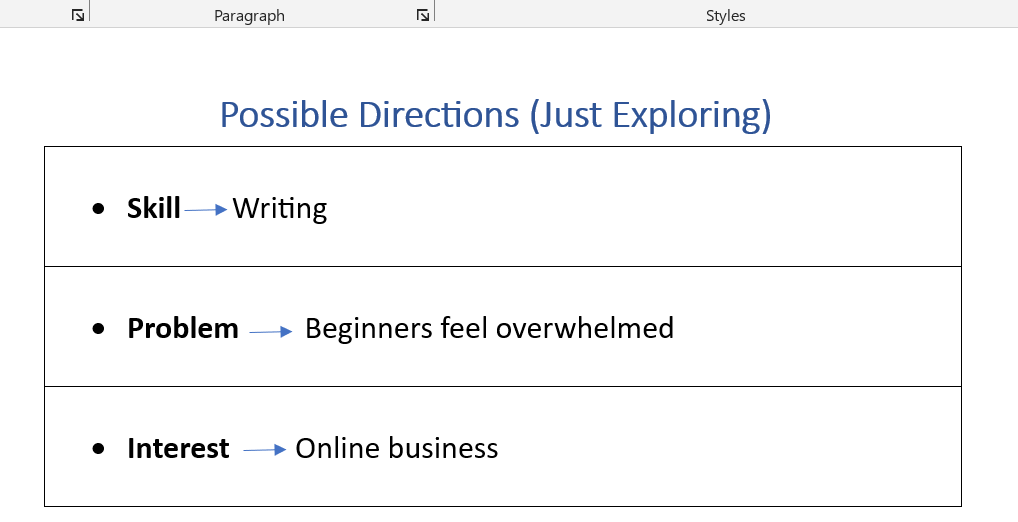
Pick one area you’re interested in:
It just has to be a starting point
- A skill you already have
- A problem you understand well
- A topic you enjoy learning about
Don’t overthink this. You can easily change it later. You’re definitely not married to your business!
Step 2: Create One Small Piece of Value
This could be:
- A short article
- A checklist
- A “how-to” guide based on your experience
Keep it simple and useful.
Step 3: Share It in One Place
Choose one platform:
- A basic blog
- A social platform you’re comfortable with
You don’t need to be everywhere. Not in the beginning anyway.
Step 4: Set Up a Simple Email Capture
Even if you only get one subscriber, that’s progress.
This is how you start building something you own.
Step 5: Repeat Weekly
Each week:
- Create one small piece of content
- Share it
- Improve slightly based on what you learn
That’s it.
No complex strategy required.
As you can see, building entrepreneurial confidence after a long corporate career isn’t about taking a big leap.
It’s about taking small, steady steps that prove to you that you’re capable of more than one path.

change more than big plans ever do
You don’t need to rush. You don’t need to risk your stability.
You just need to start.
Focus on small wins. Keep things simple. Treat this as a learning phase, not a performance.
Confidence grows from action, not from waiting until you feel ready.
And the good news is, you don’t have to feel ready to begin.
You just have to begin, whether you feel ready or not! 🙂
Here’s to great adventures!