

*This post may contain affiliate links for which I earn commissions.*
A Realistic 5-Hour-a-Week Business Plan for Busy Midlife Professionals
Life at 40-something doesn’t afford you much slack.
You’ve got a job that takes real energy, a household that doesn’t run itself, maybe aging parents who need more of you than they did five years ago.
Through all this, somewhere in the back of your mind, a quiet voice keeps saying: I want something of my own. (Truthfully, that last phrase was me from day one at my first corporate job!)
Something that could grow into real income, real freedom.
But then Monday arrives, the week swallows you whole. And Sunday evening you realize you didn’t touch that business idea at all. Again.
If that cycle sounds familiar, this post is for you.
Not because there’s some magic hack that changes everything overnight (trust me, I searched. . . never found one), but because there’s a smarter, calmer way to think about what it practically takes to build something real alongside a full life.
And believe it or not, even five focused hours a week is enough to make meaningful progress, as long as you know how to use them. Let’s walk through exactly how to do that.
Why “Find More Time” Is the Wrong Advice
Most online business content is written for people in their 20s who are sleeping on a futon and have no real obligations.
You’ve probably seen it too, it generally sounds like: wake up at 5am, grind every spare minute, sacrifice weekends, hustle until it clicks.
That model doesn’t just feel wrong for midlife professionals. It IS wrong.
You’re not starting from an energy tank at 100% with nowhere else to put it.
You’re starting from a life that’s already full of real responsibilities. Trying to bolt a hustle mentality onto that life is a recipe for burnout and resentment, not for a successful business.

So what works in real life?
Building a sustainable rhythm works. Showing up for small amounts of time, consistently over time, gets results.
A single focused hour most days of the week will carry you further than an exhausting eight-hour Saturday every few weeks. Consistency beats intensity when you’re playing a long game, and building an online business is absolutely a long game.
The goal isn’t to find more time. It’s to use each small pocket of time available to you with clear intention.
A lady whose list I was on (don’t remember her name, unfortunately) once wrote a great little ebook on this topic. She called it “Marketing in Minutes”.
The title says it all. Her message was, build your business in the little slots of time you get during your busy day. It all adds up.
The 5-Hour Weekly System (Broken Down Simply)
Here’s a practical weekly structure that works for people with real lives. It’s not a rigid schedule. Think of it as a starting shape you can then shape-shift to fit your personal situation.
Monday (1 hour): Plan and prioritize
Start your business week with clarity, not action. Spend this hour reviewing where you left off, deciding on your one or two priorities for the week.
Then write them down somewhere you’ll see them. Tools like Notion or even a plain notepad work fine here.
The point is to make a decision in advance. That way you’re not burning mental energy or spending time figuring out what to do when your hour for work finally arrives on Tuesday.
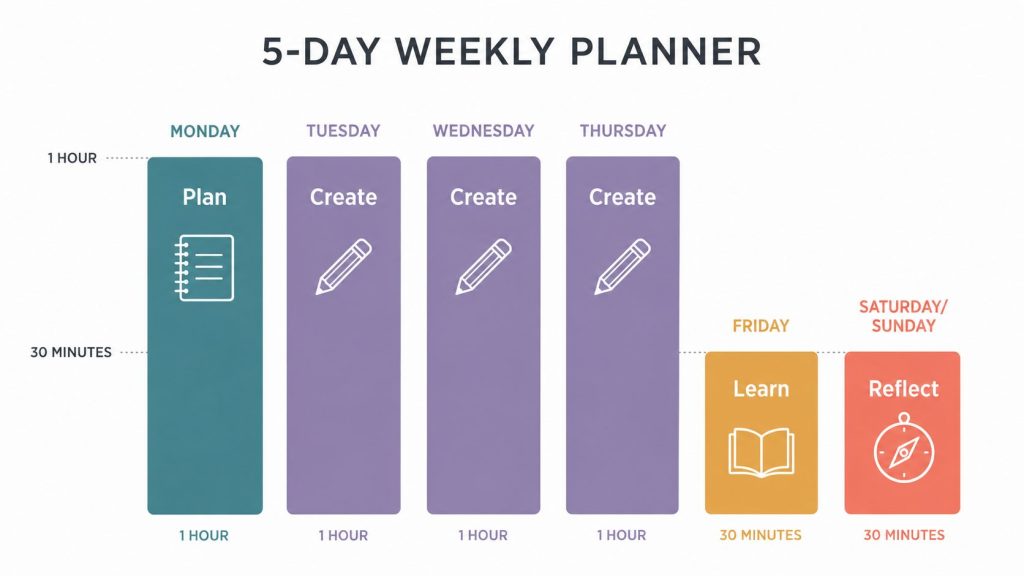
Tuesday, Wednesday and Thursday (1 hour each): Create or build
These are your “doing” days. Depending on where you are in your business, this might mean writing a blog post, setting up your email list, recording a short video, or researching an affiliate product you want to promote.
Pick one task per session, not a list of five. One thing done well is worth more than five things started and abandoned.
While on the subject, you might find The One Thing (by Gary Keller) very useful, as I did. In fact, I have it on my desk all the time to remind me of the importance of having just one top priority for the day or week.
And if you’re just getting started and don’t yet have a website, this is a good time to look at beginner-friendly platforms like Bluehost for hosting or Aweber for email. Both are genuinely approachable for non-technical beginners and have free or low-cost starting tiers.
Friday (30 minutes): Learn one thing
Your industry changes. Algorithms shift. New tools emerge.
Keeping one short learning session in your week means you stay informed without falling into the trap of constant research-as-procrastination. Listen to one podcast episode on your commute, read one good article, or watch one tutorial.
One thing. Then close the tab.
Weekend (30 minutes, flexible): Reflect and adjust
Before the week resets, spend half an hour asking yourself: What moved forward this week? What stalled, and why?
What do I want to prioritize next week?
Small weekly reflections like this keep you from drifting and help you notice your own patterns over time. That’s where the compounding starts to happen.
So don’t skip the review and reflection time. Also, you can input your week’s activities into AI and ask it to review and recommend improvements. But use your human brain before you look at AI.
That’s it. Just five hours with a simple structure. Repeated consistently week after week, you are very likely to see progress over time.
I guess that sounds too simple for some folks. If that’s you, I suggest you try out this simple schedule for just 30 days and see where it takes you. You’ll likely discover that you’ve already taken a few meaningful steps forward in your biz by then.
Protecting Your Hours Like They’re Appointments
Obviously, scheduling your five hours means nothing if you don’t fiercely protect them from being squandered away.
People who successfully build businesses in their spare time treat their business hours the same way they treat a doctor’s appointment or a work meeting.
They don’t cancel unless something is genuinely urgent. They don’t let themselves be casually interrupted.

They tell the people around them: “I’m working on something Tuesday mornings from 7 to 8. I’ll be unavailable.”
That kind of boundary-setting can feel uncomfortable, especially if you’re not used to claiming time for yourself. But it sends a signal to your brain as much as to your family: this matters. This is real. I’m taking it seriously.
I find that times where interruptions are naturally fewest work best for me. Early morning is great. I can get a LOT done between 5:30 am and 8:30 am before anyone even thinks of interrupting me.
Other such times might be lunch breaks, after the kids are in bed, or whatever window already exists in your life with the least resistance.
Don’t try to create time from nothing. Find the seam that’s already there and widen it a little.
What to Focus On in Your First 30 Days
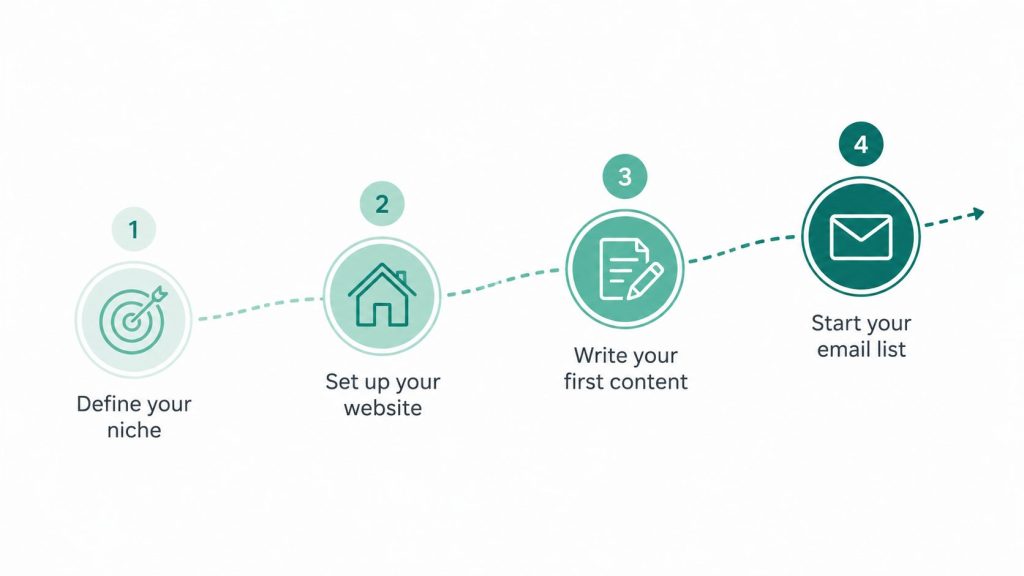
If you’re brand new and wondering where your five hours should go at the start, here’s a simple process for the first month. Rather than a tidy week-by-week list, think of it as four sequential moves.
First, define your niche and your target reader. Write one sentence that says who you help and how. Then set up your basic online home, a simple website or landing page, without overthinking the design.
Once that’s in place, write your first piece of content, whether that’s a blog post, a newsletter issue, or a short video script.
Finally, start building your email list. Even ten subscribers who truly care about your topic is a real foundation. (Email them at least a couple of times a week, preferably more often. Else they won’t even remember you.)
You won’t have a thriving business after 30 days. But you’ll have a real beginning, which is more than most people ever build.
If you want help planning this out week by week, a simple planning tool like the free version of Notion lets you build a lightweight content and task tracker without needing any tech background.
A Word on the Days You Miss
You will miss a week. Or two. A sick parent, a work crunch, a hard personal stretch, life intervenes. I once missed three weeks at a stretch due to mom’s hospitalization.
This is not failure. This is just how life is at midlife. Messy, unpredictable.
The one thing that matters is whether you come back.
I think that the quieter, more sustainable your rhythm is, the easier coming back feels. People who burn hot and hustle hard find it nearly impossible to return after a break.
Why?
Because their brain resists it big time. It does that because re-entry feels like an enormous, draining chore. No brain likes that!
On the other hand, people who built a gentle, five-hour habit find it much easier to just pick up where they left off.
Give yourself full permission to be a slow, steady builder. Slow and steady, in this case, genuinely wins.
One more thing before you go.
If you read this post and thought “Yes, this is exactly what I need to do”, and then immediately wondered whether you’d actually follow through, you’re not alone. That gap between knowing and doing is real, and it’s where most good intentions quietly die.
I run a light accountability program designed for exactly this situation. No strategies, no coaching, no one telling you what to do. Just regular check-ins, someone keeping track of your progress, and the gentle but firm external structure that makes it easier to actually show up for those five hours each week.
If that sounds like something that would help you, click here to take a look.
Starting Smart Beats Starting Perfect
You don’t need a perfect schedule, a finished website, or a clear niche before you begin. You need one hour, today, pointed at one small thing.
Do that enough times over enough weeks, and you’ll look back six months from now and be genuinely surprised at how much ground you’ve covered.
The midlife professionals who build real online businesses aren’t the ones who found some secret shortcut. They’re the ones who decided five consistent hours a week was worth showing up for. And then showed up.
Can you believe it really is that simple? 🙂